Artificial intelligence is changing many things about how products are built. For product managers, the most immediate impact is not automation or code generation. It is the ability to cross-reference product ideas against everything your team already knows — instantly, at the moment of decision.
The validation problem
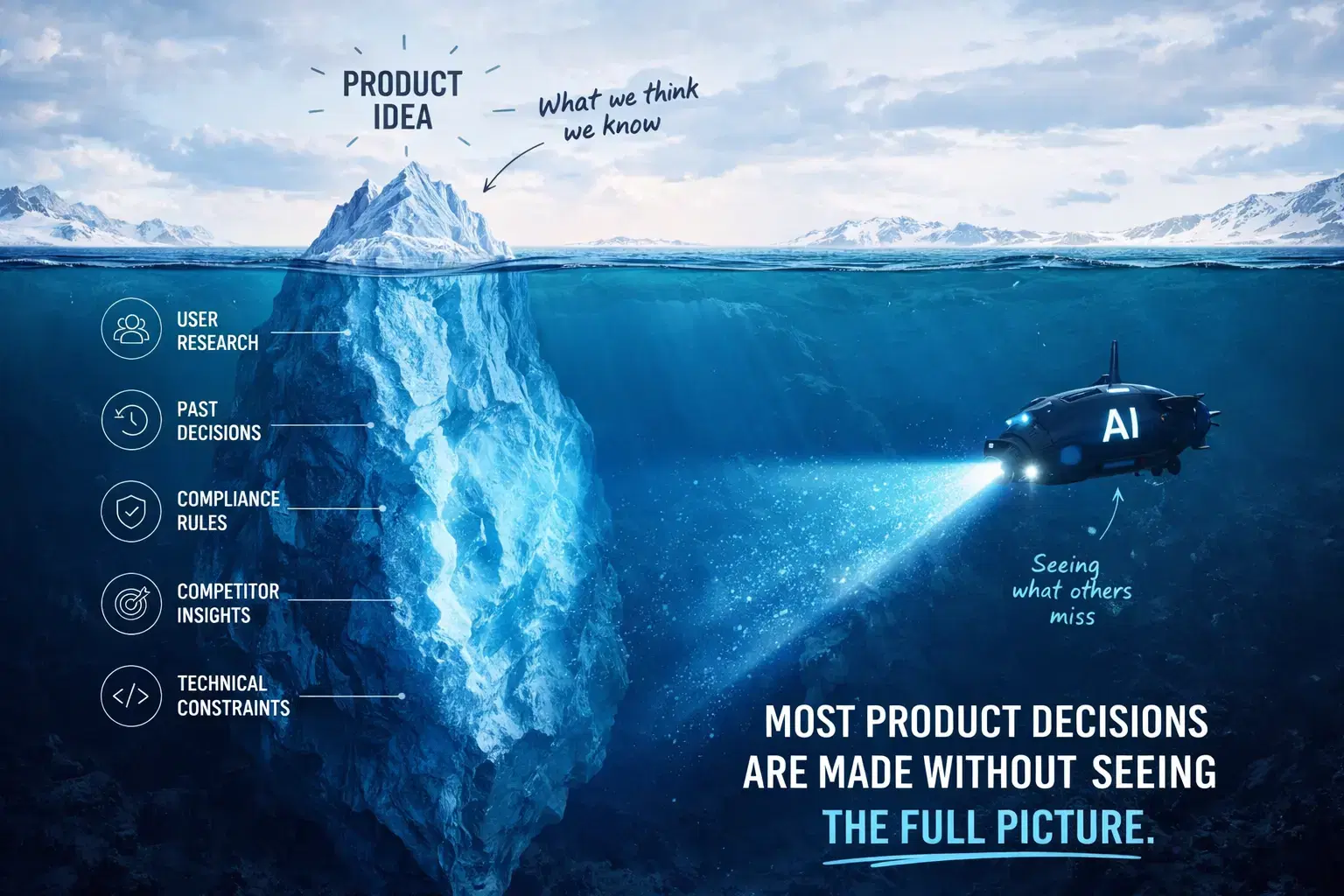
Every product idea should be validated before significant resources are committed to it. A complete validation means checking the idea against what is known about users, what regulations apply, what competitors have built, what the organization has already decided strategically, and what is technically feasible.
In practice, this validation rarely happens completely. Not because product managers are careless, but because thorough cross-referencing is time-consuming. A PM with a promising idea wants to move quickly. Running down every possible connection to existing knowledge can feel like an obstacle to progress.
The result is predictable. Teams invest in ideas that conflict with regulatory requirements they did not find. They build features that duplicate research their own team already conducted. They make decisions that contradict strategic choices made six months ago. AI validation addresses this problem not by making decisions for product managers, but by making cross-referencing fast enough to happen consistently — even under time pressure.
What AI validation actually does
There is a common misunderstanding about what "AI product validation" means. It does not mean an AI decides whether your idea is good or bad. No algorithm can make that judgment. The context, timing, market dynamics, and organizational priorities that determine whether an idea is worth pursuing require human judgment.
What AI validation does is this: it matches a product idea against a knowledge base and surfaces relevant connections and gaps. The PM reviews these connections, decides which are meaningful, and uses the pattern to make a better-informed decision.
Think of it as a colleague who has read everything your team has ever written. When you describe an idea to them, they can say: "This is similar to the user research from Q2 last year. There is also a compliance requirement that might apply — we documented it after the legal review in November. And the competitor analysis from March suggests that one competitor is building something similar." You still decide what to do with that information. The colleague has made it available to you in seconds rather than after hours of searching.
How AI cross-referencing works
Modern AI validation uses two complementary techniques to match ideas against knowledge: semantic search and entity recognition.
Semantic search and embeddings
Semantic search uses vector representations — called embeddings — to capture the meaning of text. Both the product idea and the knowledge entries are converted into numerical vectors. Entries with vectors that are mathematically close to the idea's vector are considered semantically similar, even if they use different words.
This means an idea about "simplifying the customer identity verification flow" will surface relevant connections to knowledge entries about KYC requirements, user research on verification drop-off rates, and competitor implementations of identity verification — even if those entries use none of the same terminology.
Entity recognition
Entity recognition identifies specific concepts, organizations, regulations, and products mentioned in both the idea and the knowledge base. If both the idea and a knowledge entry mention the same regulation, the same market segment, or the same technical constraint, this structural overlap is a strong signal of relevance — independent of semantic similarity.
Together, these two techniques produce a ranked list of knowledge entries most relevant to a given idea, with a confidence score for each connection that draws on both the semantic and structural signals.
Understanding confidence scores
Confidence scores tell you how strong a connection between an idea and a knowledge entry is likely to be. A well-designed confidence score breaks down into three components, each capturing a different dimension of relevance.
Structural confidence
Structural confidence measures the overlap of specific concepts, entities, and topics between the idea and the knowledge entry. If both mention the same regulation, the same competitor, or the same user persona, structural confidence is high. This component is particularly reliable for regulatory and competitive knowledge — areas where the same specific entities appear across multiple entries.
Semantic confidence
Semantic confidence measures the meaning similarity of the idea and the entry, independent of specific words. High semantic confidence means the two pieces of text are conceptually related even if they approach the topic differently. This component is most useful for surfacing user research connections — where the vocabulary of research findings often differs from the vocabulary of product ideas.
Temporal confidence
Temporal confidence adjusts the score based on how recent the knowledge entry is. A competitor analysis from five years ago should contribute less confidence than one from six months ago. This component ensures that aged information is weighted appropriately — which is why setting validity dates on knowledge entries is so important.
The final confidence score is a weighted combination of these three factors. A highly relevant but three-year-old entry might score similarly to a less directly relevant but very recent entry. Understanding the breakdown helps PMs interpret what the score means and whether the connection is worth acting on.
Interpreting confidence scores
Gap detection — knowing what you do not know
One of the most valuable outputs of AI validation is not what it finds, but what it fails to find. If you submit a product idea and the AI returns no significant connections in a knowledge domain, this is a gap signal.
A gap in user research means you do not have documented evidence that users want or need what you are proposing. This might mean the idea is genuinely novel — or it might mean the research has not been done and the assumption has not been tested.
A gap in regulatory knowledge means you do not have documented guidance on whether the idea is permissible. In regulated industries, this is a risk that must be addressed before the idea moves forward — not a reason to stop, but a reason to consult.
A gap in competitor knowledge means you do not know whether similar products already exist. This could be a genuine market opportunity — or it could mean your competitive intelligence is out of date.
Gaps are not blockers. They are research assignments. For each significant gap, a PM can assign a specific question: what user research do we need to validate this assumption? What compliance guidance applies to this feature? What competitive context are we missing? This turns knowledge gaps from invisible risks into visible work items.
Limitations of AI validation
AI validation is only as good as the knowledge base it searches. This point cannot be overstated. A knowledge base with five entries per domain will return unreliable results. The AI cannot find connections that do not exist in the base — and low coverage means that real, important connections will be missed.
Most AI validation systems have a minimum threshold — typically between five and fifteen entries per domain — below which results should not be trusted for decision-making. Below this threshold, everything looks like a gap because the knowledge base does not have enough coverage to distinguish between "this is not relevant" and "we have not captured anything about this."
AI also cannot validate things that require human judgment. Whether an idea aligns with the team's current priorities, whether the market timing is right, whether the organization has the capability to build it — these judgments remain entirely with the product manager. AI validation is a research assistant, not a decision maker.
The garbage-in problem
Getting started: a realistic path
The most common mistake when implementing AI validation is waiting until the knowledge base is "complete" before running the first analysis. This leads to months of knowledge capture before any value is demonstrated — and most teams lose momentum before they get there.
A better approach works in three phases:
Phase 1: Import what you already have (weeks 1 to 2)
Most product teams have more documented knowledge than they realize. User research reports, compliance memos, competitive analyses, PRDs — these can often be imported into a knowledge base in a short amount of time. Start with the highest-value material: recent user research, current regulatory requirements, and the last six months of competitive intelligence.
Phase 2: Run analysis immediately (week 3)
Even with sparse coverage, AI validation will return useful results. The gaps it identifies will tell you exactly where your knowledge base most needs attention. Use the first analyses to understand your coverage profile — which domains are strongest, which are weakest, and where the most significant risks are concentrated.
Phase 3: Build coverage incrementally (ongoing)
After each analysis cycle, identify the two or three knowledge domains with the weakest coverage. Focus your next knowledge capture cycle on those domains. Once you have fifteen or more entries per domain, AI validation becomes substantially more reliable — and the confidence scores become meaningful enough to guide decision-making rather than just suggesting areas for review.
The right mental model